
TORONTO, May 8, 2026 – Toronto Public Health has confirmed that the number of Legionnaires’ disease cases in the city has risen to nine, and public health officials are continuing to investigate the source of infection. As of May 7, the case count had not increased further, and public health said the overall risk to the public remains low. For seniors, people with chronic illnesses, those with weakened immune systems, and families living near apartment buildings, seniors’ residences, or long-term care facilities, any fever, chills, cough, or possible pneumonia symptoms should be taken seriously, and medical advice should be sought promptly rather than treating it as an ordinary cold.
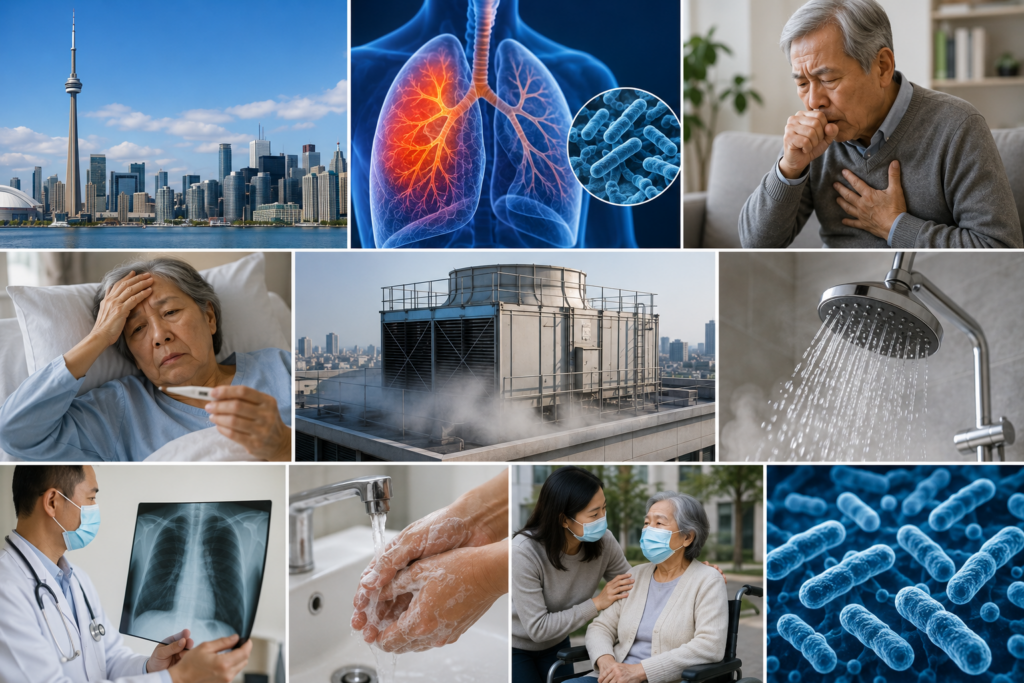
Legionnaires’ disease is a respiratory illness that can cause pneumonia and is caused by Legionella bacteria. According to public health information, Legionella is commonly found in water environments and can grow in poorly maintained man-made water systems, such as cooling towers, humidification equipment, or large building water systems. Infection is usually linked to inhaling tiny water droplets containing the bacteria, and it does not spread from person to person in the same way as common respiratory viruses.
The most important message in this situation is not for residents to panic or try to determine the source of infection on their own, but for higher-risk people to recognize symptoms early. Legionnaires’ disease may cause high fever, chills, cough, shortness of breath, muscle aches, or other pneumonia-like symptoms. For otherwise healthy adults, the risk is relatively lower. But for older adults, long-term smokers, people with chronic lung disease, or those with weakened immune systems, the illness may become more serious.
For many Chinese families, one common problem is that when an elderly family member develops a cough, fever, or breathing discomfort, relatives may first assume it is a seasonal cold, allergies, or an ordinary cough and decide to monitor the person at home. If symptoms continue to worsen, especially if there is difficulty breathing, chest discomfort, persistent high fever, or obvious weakness, the person should contact a family doctor or go to a clinic or emergency department for assessment as soon as possible.
At present, Toronto Public Health has not released a specific exposure location and has said that it will not disclose such information because of patient privacy. The health department is still investigating the source. Residents should not rely on rumours on social media to guess whether a particular apartment building, mall, or community facility is involved, and they should not spread unconfirmed location information.
For apartment residents, seniors’ residence tenants, and families visiting long-term care facilities, it may be useful to pay attention to notices from building management and public health. If a building has recently had work involving its water system, cooling equipment, or major maintenance, residents can ask property management about cleaning and maintenance records. However, ordinary residents do not need to inspect building equipment themselves, nor should they stop normal water use. The priority is to seek medical care quickly if symptoms appear and to tell a doctor about recent living, work, or activity environments.
If there are elderly parents, people with chronic illness, or immunocompromised family members at home, relatives can remind them to watch for fever, cough, and breathing changes, and keep health cards, medication lists, and family doctor contact information ready. If an older adult has difficulty communicating in English, family members should also help record when symptoms began, how the temperature changed, and where the person has recently been, so that the information can be explained clearly during medical care.
Until the source of infection is confirmed, the public should stay informed but avoid panic. For the general public, Legionnaires’ disease does not spread through ordinary contact, sharing a meal, or brief conversation with an infected person. For higher-risk groups, if pneumonia-like symptoms appear, getting medical care promptly is more important than trying to guess the source. If Toronto Public Health releases further investigation results, residents should rely on official information. (LJI by Yuanyuan)